The post Top Six Altcoins To Stack As CLARITY Act Progresses appeared first on Coinpedia Fintech News
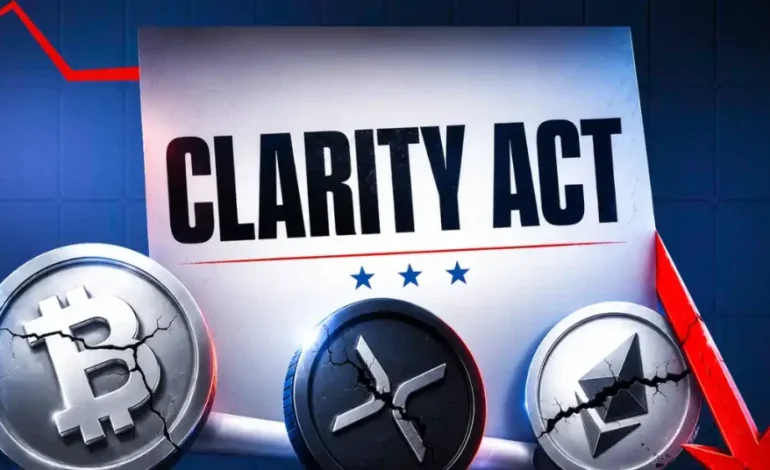
The proposed U.S. CLARITY Act is becoming one of the biggest catalysts that crypto investors are watching in 2026. The bill recently passed committee with bipartisan support and is now expected to move toward a full Senate vote in the coming weeks.
Galaxy Digital’s Alex Thorn said there is now a 75% chance the legislation passes before the August recess. Many in crypto are comparing the CLARITY Act and GENIUS Act to the Securities Acts of 1933 and 1934, which helped create long-term dominance for U.S. capital markets.
Several crypto projects are now being viewed as potential winners if the bill moves forward.
Altcoins to Watch If the CLARITY Act Passes
1. Ethereum (ETH)
Ethereum remains the biggest institutional blockchain play. Most tokenization activity, stablecoins, and DeFi infrastructure already operate on Ethereum. Fundstrat’s Tom Lee recently bought another 71,000 ETH, arguing that global financial assets worth hundreds of trillions could eventually migrate onto blockchains.
2. XRP (XRP)
XRP is gaining momentum through Ripple’s growing institutional infrastructure. Ripple Prime recently partnered with EDX Markets, an exchange backed by Charles Schwab, Fidelity, Citadel, Goldman Sachs, and former CME executives. Supporters believe XRP is positioning itself as a bridge asset for institutional liquidity, settlement, and tokenized finance once regulations become clearer.
3. Bittensor (TAO)
Bittensor continues emerging as one of crypto’s biggest decentralized AI projects. The network recently expanded visibility ahead of its Proof of Talk conference in Paris. Supporters view TAO as a decentralized alternative to centralized AI companies like OpenAI, especially as the AI market rapidly expands.
4. Sui (SUI)
Sui is pushing aggressively into stablecoin infrastructure. The project announced plans to enable free stablecoin transfers at any scale, from microtransactions to billion-dollar transfers. Developers think frictionless money movement could become a major competitive advantage as tokenized assets move on-chain.
5. Solana (SOL)
Solana continues attracting both institutional and retail attention. JPMorgan recently disclosed a $500,000 position in Bitwise’s Solana staking ETF. Meanwhile, seven Solana-based applications reportedly generated eight-figure revenues in Q1 2026 despite weak overall market sentiment, showing continued ecosystem activity.
6. Chainlink (LINK)
Chainlink is becoming deeply integrated into traditional finance infrastructure. The DTCC is now integrating Chainlink’s data and orchestration standards into its collateral systems. Since the DTCC processes over $3.7 quadrillion annually, many see this as one of the strongest institutional validation signals for blockchain infrastructure.